
Overview
Learn algorithms and data structures with reference to Algorithm Encyclopedia.
The implementation is also available on github - bmf-san/road-to-algorithm-master.
List (Singly Linked List)
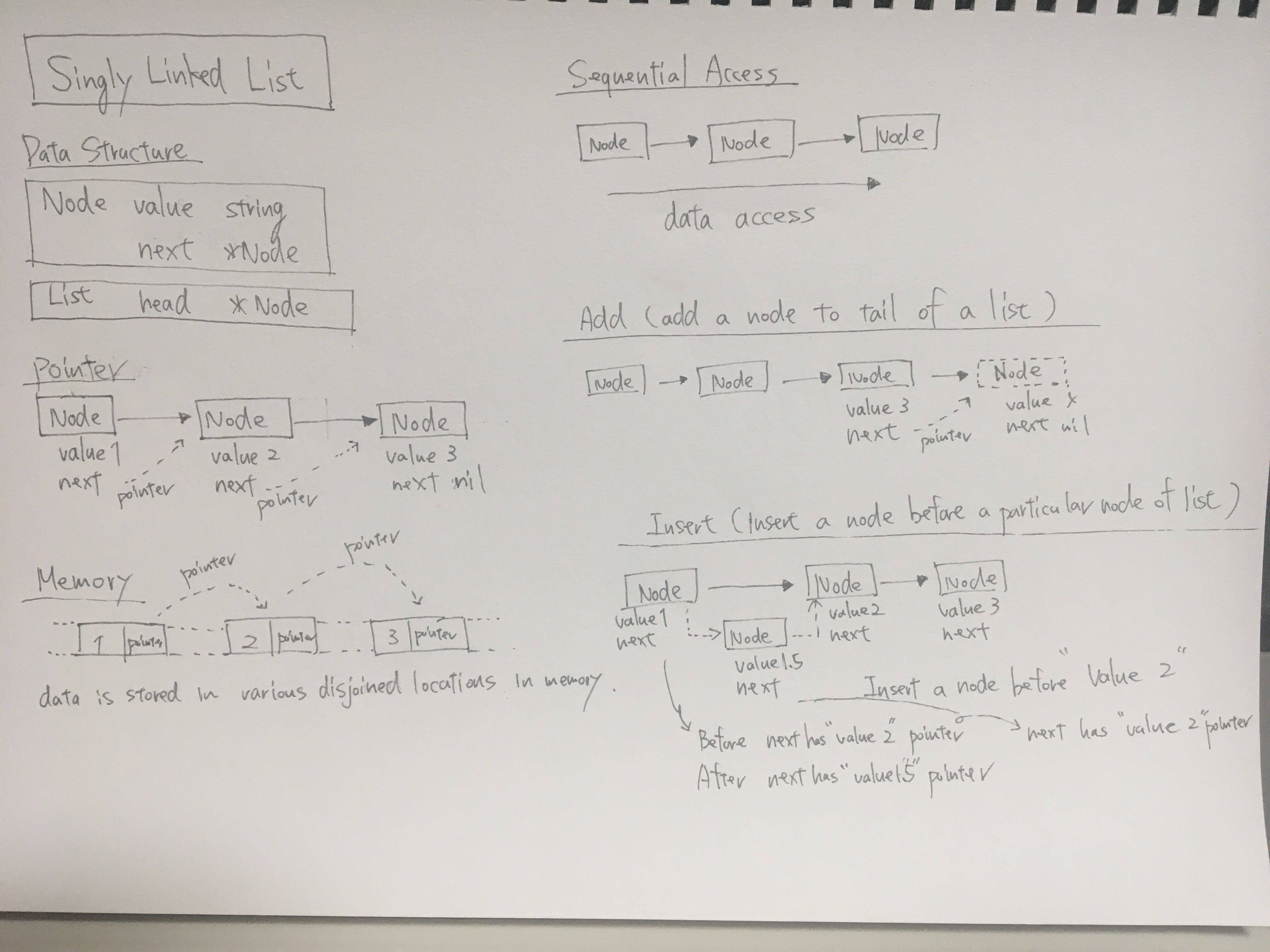
- A structure where data is arranged in a straight line
- Each node has a pointer to the next node
- Adding and deleting data is easy, but accessing data takes time
- In a list, data does not need to be stored in contiguous memory areas
- Generally stored in separate areas
Computational Time
Let n be the number of data stored in the list.
Accessing Data
- O(n)
- Since sequential access from the beginning of the data is necessary, it takes linear time
Adding Data
- O(1)
- Assuming data access to the addition point is complete, it only requires swapping two pointers, so it takes constant time
Deleting Data
- Same as adding data
Implementation
Linear List
Singly Linked List
package main

import (
	"errors"
	"fmt"
)

// A node is a node of list.
type node struct {
	value string
	next  *node
}

// A list is a singly linked list.
type list struct {
	head *node
}

// add add a node to tail of a list.
func (l *list) add(newn *node) {
	if l.head == nil {
		l.head = newn
		newn.next = nil
		return
	}

	// sequential access
	for n := l.head; n != nil; n = n.next {
		if n.next == nil {
			n.next = newn
			return
		}
	}

	return
}

// insert a node before a particular node of a list.
func (l *list) insert(newn *node, v string) error {
	if l.head == nil {
		return errors.New("a target node is not exists")
	}

	// sequential access
	for n := l.head; n.next != nil; n = n.next {
		if n.next.value == v {
			newn.next = n.next
			n.next = newn
			return nil
		}
	}

	return errors.New("a target node is not exists")
}

// display display all nodes of a list.
func (l *list) display() {
	// sequential access
	for n := l.head; n != nil; n = n.next {
		fmt.Println(n.value, n.next)
	}
}

func main() {
	l := &list{}

	first := &node{"first", nil}
	second := &node{"second", nil}
	third := &node{"third", nil}

	l.add(first)
	l.add(second)
	l.add(third)

	between := &node{"between", nil}
	l.insert(between, "second")

	l.display()

	fmt.Printf("%#v\n", l)
}
- The List struct stores the head node of the list
- Because data access in the list is done sequentially
- add
- A method to add a node to the end of the list
- insert
- A method to add a node before a specified node in the list
- Identify the position to add → adjust the pointer of the node before the addition position and the pointer of the node to be added
- When identifying the position to add, refer to the pointer of the next node in the loop and determine if the value of the next node matches the specified value
- A method to add a node before a specified node in the list
- Note
References
Naim Ibrahim - Golang singly linked list- The implementation was easy to understand