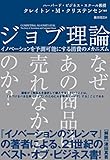
I read Jobs Theory: The Mechanism of Consumption that Makes Innovation Predictable.
Engineers are creatures that solve problems, but sometimes there are moments when they need to sincerely face the question of what problems users want to solve.
I thought this is a theory I want to keep in mind and refer to during such times.
Word Notes
- Job
- The problem the customer wants to solve
- Jobs Theory
- Explains what customers buy and what they don't
- Jobs to be Done
- The progress customers try to achieve in their given situation
- Customers don't consume because they want to consume, but because they want to solve "something."
- The progress customers try to achieve in their given situation
- Hiring a Job
- A metaphor for consumption, but consumption for the progress they want to achieve
- Little Hire
- How to use what is bought
- Innovation requires analysis of Little Hire
- Something like experiential value (as I interpret it...)
- Big Hire
- What to buy
- The data companies collect tends to focus on this Big Hire
- Data Arbitrariness
- Data that appears objective contains the arbitrariness of the creator
- Use data to grasp correlations and capture causality with Jobs Theory
Reference Links for a Quick Overview
- ja.wikipedia.org - Jobs Theory
cs2.toray.co.jp - Overview of Jobs Theory- www.indee-jp.com - Jobs Theory: A System to Unravel the "Needs" That Were a Mystery Until Now
- www.peaks-media.com - What is Jobs Theory? Explained Clearly with Frameworks and Examples
- www.sbbit.jp - A Gentle Explanation of 'Jobs Theory', There is a "Pattern of Success" in Innovation
crescent-acc - Jobs Theory – What Customers Really Want, Even if They Don't Know It Themselves- ds-note.net - Summary of 'Jobs Theory' in 10 Minutes
Impressions
Understanding the user's "job" is probably not an easy task.
There was a discussion in the latter half about how defining jobs can make an organization function well, which I found quite interesting.
Due to the nature of the engineering job, it's easy to focus on technology, but this book made me realize once again that I should cultivate more business sense and theory.
There are many similar topics, like "Users don't know what they want," or "What the customer really wanted was... (the tire swing)," so I felt there were some commonalities.