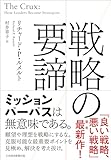
This is a follow-up to Good Strategy/Bad Strategy by Richard P. Rumelt.
Of the strategy framework introduced in the previous book—diagnosis, guiding policy, coherent action—this one digs deep into diagnosis: identifying the "crux" hidden inside a tangled set of problems.
Points that stood out:
- Strategy is not the act of working backward from a goal you want to reach; it is the act of narrowing down which problem to tackle.
- Many "strategies" simply line up goals and aspirations without examining solvability, and so never translate into action.
- Within a cluster of problems, the single point that, once cracked, moves the rest is the "crux." Identifying it and concentrating resources on it is the essence of strategy.
- Diagnosis starts by resisting the urge to abstract too early and instead observing the problem at a concrete level.
The book leans heavily on case studies, walking through how Rumelt diagnoses the strategy of various companies and organizations. It is enjoyable as a read, and it nudges you to reframe your day-to-day problems with questions like "Is this really the problem to solve?" and "Can I narrow this down further?"
If you have read Good Strategy/Bad Strategy, this picks up naturally from there. Reading the previous book first makes the shared vocabulary and assumptions easier to follow.